
Beyond Vector Databases: Structured Retrieval and Graph-Native AI Systems
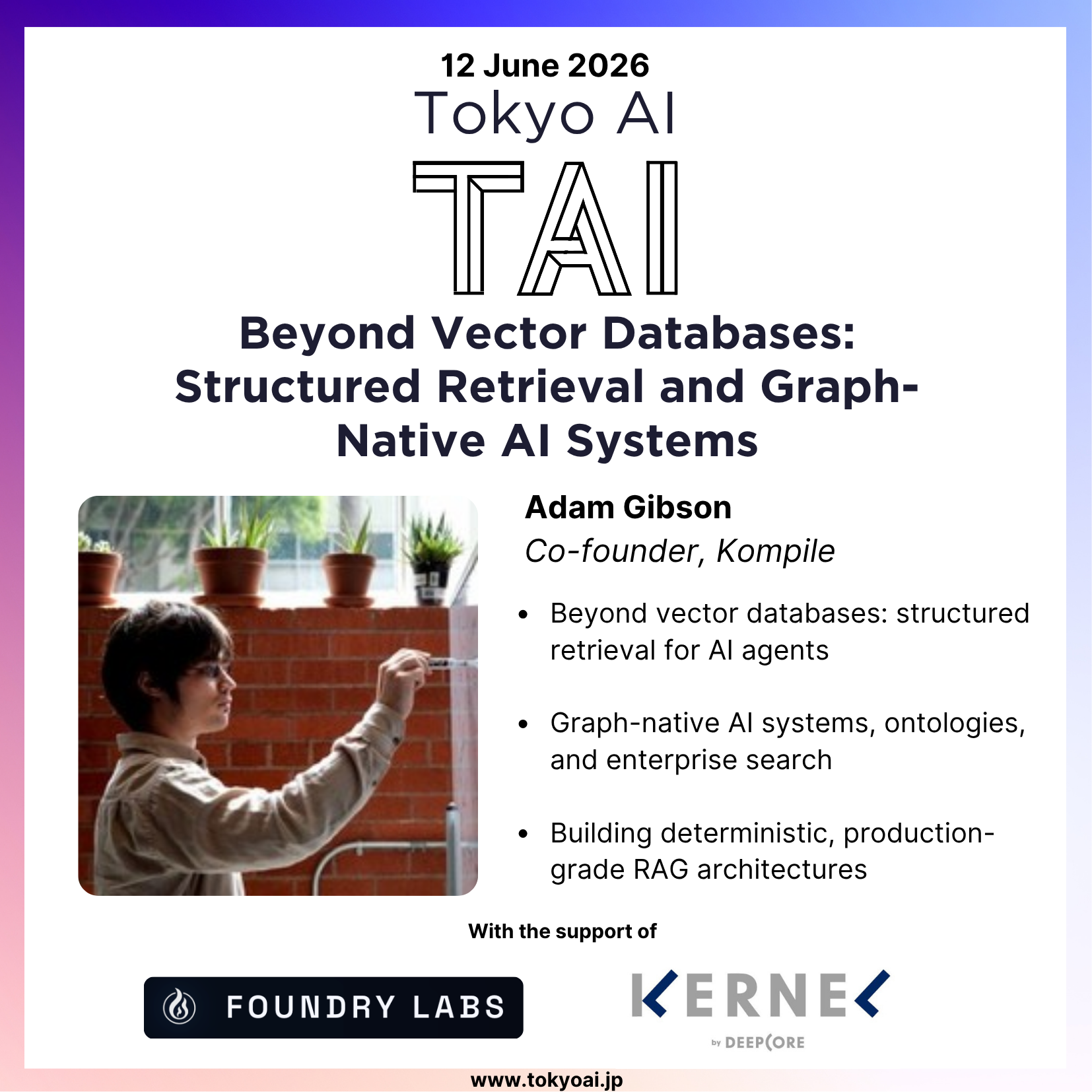
Tokyo AI workshop on grounding AI agents with structured, graph-native retrieval instead of vector databases — a two-part talk by Adam Gibson.
- When
- Fri, June 12, 2026 · 18:00–21:00 JST
- Where
- Bunkyo City, Japan · In person
- Region
- Kanto (Tokyo)
- Organizer
- Tokyo AI
- Language
- EN
- Source
- Luma
Summary
This Tokyo AI workshop examines retrieval architectures that ground AI agents without depending solely on embeddings and vector databases. The premise is that vector-centric Retrieval-Augmented Generation works well for static, unstructured corpora but becomes hard to maintain when data is highly structured, relational, and rapidly changing. Across two technical sessions, the speaker presents relational databases, graph structures, ontologies, keyword search, and tool-mediated retrieval as alternatives.
Part 1 covers structured context engineering for AI agents, using an AI-powered virtual tabletop RPG platform as a case study for relational grounding, deterministic retrieval, context assembly under token constraints, and MCP-style retrieval patterns. Part 2 turns to graph-native systems, exploring how ontologies and knowledge graphs enable more precise retrieval, explainable reasoning paths, and dynamic exploration compared with flattening information into embedding spaces. A networking hour follows the talks.
The content targets engineers, researchers, and technical leaders building production AI systems, enterprise knowledge platforms, agentic workflows, or retrieval infrastructure. The speaker is Adam Gibson, cofounder of Kompile, formerly Skymind, and author of O'Reilly's Deep Learning: A Practitioner's Approach.
About the community
A large AI community based mainly in Tokyo, bringing together engineers, researchers, investors, product managers, and corporate innovation managers. It runs recurring technical talks and networking sessions aimed at growing the local AI ecosystem, conducted in English.
#ai#rag#knowledge-graph#ai-agents#retrieval#vector-database#ontology#machine-learning#knowledge-graphs